Valley Murals Turn San Luis Valley Walls Into Stories |
Public art, historic murals and local heritage create an outdoor gallery across the region |
SAN LUIS VALLEY — Some of the Valley's most interesting stories are not tucked inside books or museums.
They are painted across walls, silos, post offices and public spaces from the northern end of the Valley to communities near the New Mexico line.
Taken together, the Valley murals form an informal outdoor gallery filled with agriculture, wildlife, faith, water, history and portraits of people who helped shape this place.
They also make a good excuse to slow down and look more closely at communities we may normally drive through without stopping.
One of the oldest and most unusual examples is not on a building at all.
At Penitente Canyon northwest of Del Norte, a blue Madonna painted high on the canyon wall is associated with Los Hermanos Penitentes and is believed to date to around 1937.
Today the canyon is widely known for climbing, hiking and mountain biking, but the painted Madonna remains a reminder of the area's religious and cultural history.
In Alamosa, the exterior of the San Luis Valley History Museum offers another kind of history lesson.
Artist and Adams State University alumnus Ian Wilkinson created a series of paintings based on community input about the Valley's past, present and future.
The work turns the museum itself into part of the exhibit, giving visitors something to study before they ever walk through the door.
Alamosa's public-art story continues in other places as well, including newer murals and artwork that bring color to community spaces.
But travel south on U.S. 285 and the mural trail becomes especially rich.
Much of that story is connected to San Luis Valley native Fred Haberlein, known professionally as Lightning Heart.
His work appears throughout Conejos County and elsewhere in the Valley, often drawing on regional history, animals, landscapes and cultural traditions.
In La Jara, Haberlein murals can be found at several locations, including the post office and along the highway corridor.
Documented works include large images of wild horses and rams, along with the interior Conejos High Country mural at the La Jara Post Office.
These are not small decorations tucked into corners.
Some stretch for dozens of feet, turning otherwise ordinary walls into landmarks.
Continue toward Manassa and the subject changes from wildlife and landscape to one of the Valley's best-known native sons.
Jack Dempsey, the heavyweight boxing champion nicknamed the Manassa Mauler, is remembered in public art as well as at the community's museum and park.
An eight-by-twelve-foot Haberlein portrait appears at the Jack Dempsey Museum, while a much larger Main Street mural titled Dempsey in 1921 recalls the boxer's rise to international fame.
For a town of Manassa's size, the murals provide a striking reminder that one of America's most famous early sports figures began life in this corner of Colorado.
Farther south, Antonito may offer the Valley's most concentrated collection of murals.
The town's Main Street and surrounding blocks hold works that tell stories of settlement, faith, water, Indigenous influence and the landscapes of the Conejos River region.
One of the largest is History of the Conejos River Region, a Haberlein mural measuring roughly 16 feet high and 100 feet long.
Nearby works include Miracle at Tepeyac, Ojo de Dios, Mimbres Rabbit, Mimbres Trout and Quetzalcoatl de Nuevo Aztlan, the Great Water Serpent of the Rio Grande.
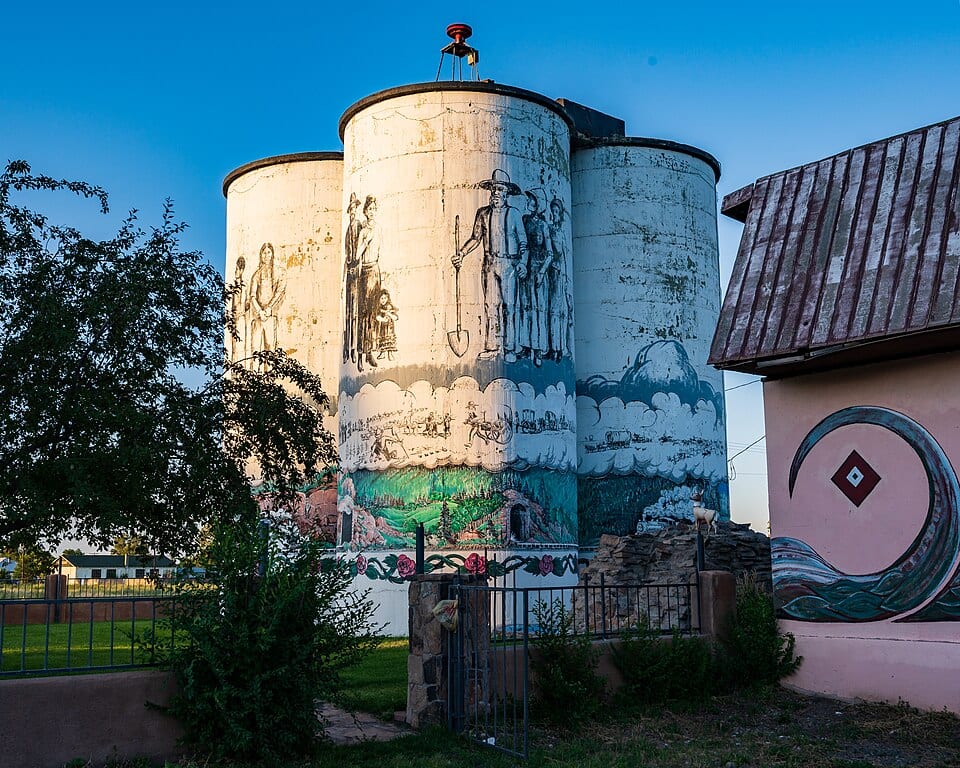
Four tall silos in a Main Street park carry another Haberlein work, The History of the San Luis Valley.
Instead of presenting history as a timeline behind glass, Antonito places much of it outside where anyone passing through town can encounter it.
The wider Conejos County mural collection extends beyond Antonito, La Jara and Manassa.
Romeo has The Evening Star, south of Romeo a silo carries a large image of whooping cranes, and the village of Guadalupe has a pointillist mural of Our Lady of Guadalupe painted on a community water tank.
Conejos itself includes an interior post-office mural depicting the old plaza.
Altogether, the county's documented mural guide identifies 20 works, making the southern Valley particularly rewarding for anyone interested in public art.
The subjects matter because they reveal what communities choose to remember.
Wild horses and cranes speak to the Valley's landscape and wildlife.
Dempsey represents a local story that reached the world stage.
Religious imagery reflects traditions carried into the Valley over generations.
Murals centered on the Rio Grande and regional history remind viewers that water, land and settlement have always been intertwined here.
Seen together, Valley murals become more than decoration; they form a visual record of local identity.
They can also change the way a familiar drive feels.
A trip down U.S. 285 through La Jara, Manassa and Antonito can become a public-art tour simply by allowing extra time to stop safely and look around.
A visit to Alamosa's museum can begin outside instead of at the front desk.
A day at Penitente Canyon can include a glimpse of a historic image left on stone nearly a century ago.
And because public art continues to evolve, the Valley's outdoor gallery is not finished.
New artists and community projects continue adding their own chapters to walls and gathering places around the region.
The best way to explore these murals is slowly and respectfully.
Several documented murals are on private property, so they should be viewed from public roads unless permission is given, and drivers should pull completely off the roadway before stopping for photographs.
For residents who have traveled these highways for years, that slower pace can reveal something surprising.
A wall passed dozens of times may suddenly become a portrait, a history lesson or a reminder of a story nearly forgotten.
That is what makes the murals such a natural fit for Around the Valley.
They are destinations, but they are also part of the everyday landscape.
Sometimes the next place worth discovering is not at the end of a mountain trail or a dirt road.
Sometimes it is painted on the side of a building you have driven past for years. |
0 Comments
Join the conversation
Be the first to comment
Share your thoughts above.