
Where History Meets the Rio Grande |
The Outdoor Classroom at Lobatos Bridge |
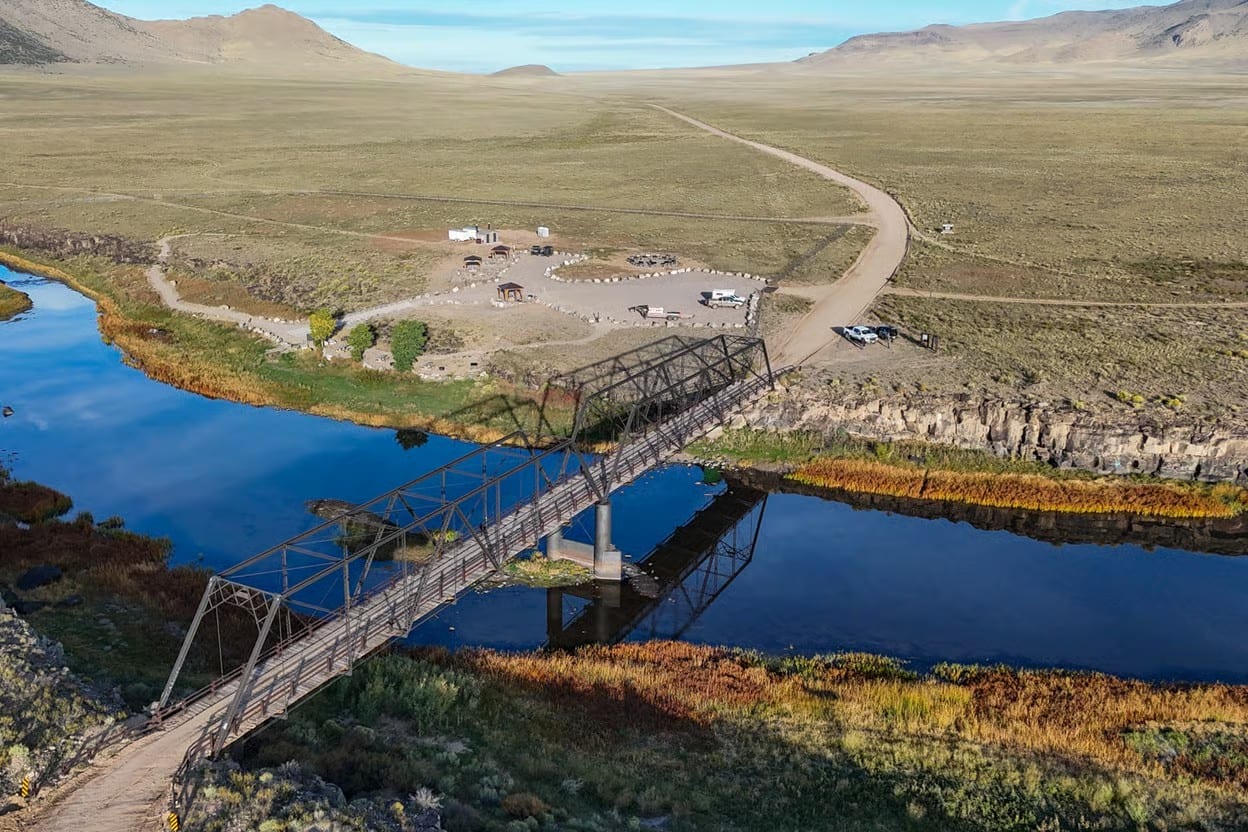
At a quiet crossing of the Rio Grande in the southern San Luis Valley, an old iron bridge has watched more than a century of Valley history pass beneath its steel framework.
Today, Lobatos Bridge is becoming a place not only to cross the river, but to stop, explore and learn.
The Lobatos Bridge Outdoor Classroom and Recreation Enhancement Project has transformed the area surrounding the historic bridge into a destination where history, education and outdoor recreation come together along one of the San Luis Valley's most important waterways.
Completed in 2025, the project includes an outdoor classroom, interpretive displays, improved trails, picnic areas, shade structures, restrooms, improved parking and a concrete boat ramp providing better access to the Rio Grande.
But perhaps the most interesting part of the project is the story the site tells. A Classroom Without Walls
Instead of desks and chalkboards, the classroom at Lobatos Bridge has the Rio Grande, the surrounding landscape and generations of Valley history.
Interpretive panels help visitors explore the natural and cultural history of the area, including Indigenous connections to the land, early settlement, agriculture and the communities that developed along the river.
Native Tribes participated in developing portions of the educational material, helping tell the story of life in the San Luis Valley long before European settlement.
The surrounding landscape carries evidence of thousands of years of human activity. Great Outdoors Colorado has described the Lobatos Bridge area as representing more than 10,000 years of human history.
That makes the classroom useful not only for visiting students, but for anyone interested in understanding how people have lived alongside the Rio Grande for generations. The Bridge That Has Watched It All
Standing over the river is the landmark that gives the site its name.
The historic Lobatos Bridge, also known as the Costilla Crossing Bridge, dates to 1892. Before the bridge was built, travelers crossed the Rio Grande here using a cable-car system. Construction of the iron bridge created an important connection between communities on opposite sides of the river.
More than 130 years later, the bridge remains. Its iron truss construction is now uncommon, making Lobatos Bridge an important surviving example of early bridge engineering in Colorado.
And unlike many historic bridges that have been closed to vehicles or moved to parks, Lobatos Bridge continues to serve as a road crossing between Conejos and Costilla counties. Drivers crossing today are traveling the same route generations of Valley residents used before them. Stories From Along the River
The history surrounding Lobatos Bridge extends well beyond the structure itself. Families settled, farmed and conducted business near this stretch of the Rio Grande during the early development of the southern San Luis Valley.
One of the stories interpreted at the site involves the Mondragon family, who operated a store near the river during the 1800s. The area also has connections to Maria Leonora “Lenore” Lujan, an Ohkay Owingeh Pueblo woman associated with a homestead in the area and among the early Native American women to receive a federal land patent.
Stories such as these help turn what might otherwise appear to be an isolated bridge in the countryside into something much larger — a window into the people who helped shape the San Luis Valley. A New Place to Experience the Rio Grande
The project wasn't designed only for history lessons.
Improvements around Lobatos Bridge have also made the site more welcoming for people simply looking to spend some time outdoors. Visitors can picnic, walk the trails, watch wildlife, fish or enjoy the river. A new concrete boat ramp provides improved access for rafting and other river recreation.
The site is within the Bureau of Land Management's Rio Grande Natural Area, which follows roughly 33 miles of the Rio Grande through the southern Valley.
It's a landscape that can sometimes be overlooked by travelers heading toward better-known destinations. Yet here the Rio Grande winds through open country beneath the enormous San Luis Valley sky, with distant mountains framing a landscape that has changed surprisingly little in appearance over generations. Nearly 40 Years in the Making
Perhaps one of the most remarkable things about the Lobatos Bridge project is how long people worked to make it happen.
The outdoor classroom and recreation improvements grew out of nearly four decades of community planning and grassroots efforts.
Eventually, Conejos and Costilla counties joined with numerous organizations and agencies to bring the project to completion. Great Outdoors Colorado provided more than $350,000 toward the project, with additional support coming from public agencies, local governments and nonprofit partners. The overall project represented an investment of nearly $700,000.
Partners have included the Bureau of Land Management, Conejos and Costilla counties, Great Outdoors Colorado, the Colorado Water Conservation Board, the Rio Grande Basin Roundtable, Sangre de Cristo National Heritage Area, Adams State University and others.
In 2026, the project received additional recognition when it was selected for a Colorado Lottery Starburst Award, which recognizes projects using Lottery proceeds to create lasting benefits for Colorado communities. Worth Taking the Back Road
Lobatos Bridge isn't surrounded by souvenir shops, restaurants or crowds. That's part of what makes it special.
It's a place where you can stand beside the Rio Grande, look at an iron bridge built in 1892 and consider all the people who have crossed, worked and lived along this stretch of river — not simply during the last century, but across thousands of years. The new outdoor classroom gives those stories a place to be told.
And for San Luis Valley residents, it provides another reason to explore a corner of the Valley that many of us may have driven past, heard about or simply never taken the time to visit.
Sometimes discovering the San Luis Valley doesn't require traveling very far.
Sometimes it just means taking the back road, stopping at an old bridge and taking the time to see what's there. Sources: Bureau of Land Management, Great Outdoors Colorado, Colorado Lottery, Great Outdoors Fund and Colorado Public Radio. ``` |
3 Comments
Join the conversation
Fantastic article! Well written and informative. Can’t wait to check out the Lobatos Bridge
Where is this bridge?
County Road G, near Antonito and San Luis, CO