The Potato and the Valley |
A Crop, a Community and 20 Years of Celebration |
Drive across the San Luis Valley in late summer and the evidence is all around you.
Long green fields stretch beneath an enormous blue sky. Irrigation sprinklers sweep across the landscape, trucks begin appearing on rural roads, and before long another potato harvest will be underway.
For generations, potatoes have been much more than something grown in the San Luis Valley. They have provided livelihoods, supported families, created businesses and helped shape agricultural communities throughout the Valley.
And every September, we celebrate them.
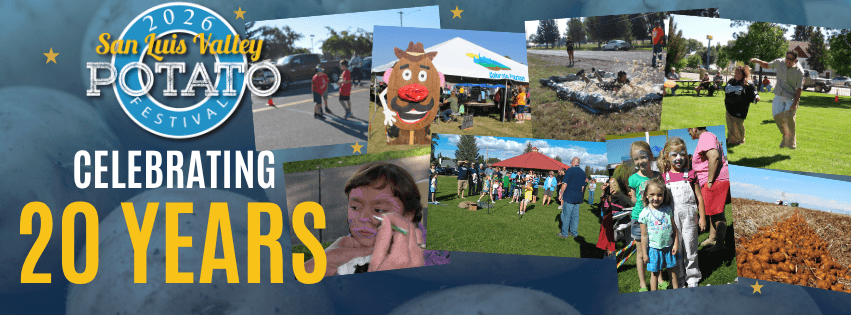
This year that celebration reaches a milestone as the San Luis Valley Potato Festival celebrates 20 years of bringing agriculture and community together. Potatoes Put Down Roots in the Valley
Potato growing in the San Luis Valley dates to the late 1800s, making this one of the country's longstanding potato-growing regions.
The Valley turned out to be remarkably well suited for the crop. At roughly 7,600 feet above sea level, growers have abundant sunshine, warm summer days and cool nights. Mountain snowmelt and the Rio Grande watershed have historically supplied irrigation water, while the Valley's high elevation and cold winters help create growing conditions particularly suited to potatoes.
By the 1880s, farmers around Del Norte, Saguache and other Valley communities were producing potatoes commercially. In those early days, wagonloads of potatoes were hauled out of the Valley, including shipments destined for Colorado's booming mining communities.
The arrival and expansion of the railroad changed everything. Suddenly, Valley farmers could reach markets far beyond southern Colorado. Monte Vista developed into an important agricultural shipping center, and potatoes became increasingly intertwined with the economy of the central San Luis Valley. More Than a Century of Potato Research
Growing potatoes here hasn't simply been a matter of planting them and hoping for a good harvest.
The Valley has also played an important role in agricultural research. An agricultural experiment station was established in the San Luis Valley in 1888. After moving north of Monte Vista in 1891, researchers placed increasing emphasis on potatoes.
That work eventually evolved into today's Colorado State University San Luis Valley Research Center near Center, where potato research, breeding, disease management and seed certification continue.
The connection between researchers and growers has helped the Valley potato industry adapt through changing markets, new technology, pests, disease and the increasingly important challenge of conserving water. An Industry Built by Generations
For many Valley families, potato farming isn't something that began with the current generation. It was handed down.
Fields have passed from parents to children and grandchildren. Packing sheds, storage facilities, trucking companies, agricultural suppliers and other businesses grew alongside the farms. In 1941, the Colorado Potato Administrative Committee was established to support San Luis Valley potato growers and promote their crop.
Today, approximately 90 percent of Colorado's potatoes are grown in the San Luis Valley, making potatoes one of the most recognizable agricultural products to come from our corner of Colorado.
Russets may be the potato most people immediately recognize, but Valley growers produce reds, yellows, fingerlings and specialty varieties as well.
What appears to be a simple bag of potatoes in a grocery store represents months of work — preparing fields, planting, irrigating, monitoring the crop, harvesting, storing, grading, packing and finally shipping it to consumers.
And behind that bag may be a Valley family that has been doing the job for generations. From Harvest to Celebration
That agricultural heritage is what makes the San Luis Valley Potato Festival more than an ordinary food festival.
The annual celebration gives those of us who don't spend our days in the fields an opportunity to connect with one of the industries happening right outside our doors.
For 20 years, the festival has combined agriculture with the kind of community celebration the Valley does so well — food, families, local vendors, activities and plenty of potatoes.
Some traditions have become almost synonymous with the festival, including the Tater Trot 5K, agricultural tours and the wonderfully messy Mashed Potato Dunk Tank.
Agricultural tours are particularly fitting. They provide an opportunity to see where our food actually comes from and meet some of the people responsible for producing it.
That's an important connection in an agricultural community. We may drive past potato fields every day without giving them much thought. The festival gives us a reason to stop and appreciate what's happening in those fields. Celebrating 20 Years in 2026
The 2026 San Luis Valley Potato Festival will be held Saturday, September 12, at Chapman Park in Monte Vista. Plans include the annual Tater Trot 5K, craft and food vendors, guided agricultural tours, a chef demonstration, freshly harvested Colorado potatoes and, of course, the famous Mashed Potato Dunk Tank.
Additional activities are expected to be announced as the festival approaches.
But perhaps the biggest attraction isn't any individual activity. It's what the day represents.
For one September day, farmers, families, businesses and visitors gather in Monte Vista to celebrate something that has helped sustain the San Luis Valley for well over a century. A Celebration of the Valley Itself
Twenty years of the Potato Festival is certainly worth celebrating. But behind those 20 festivals are well over 100 years of Valley agricultural history.
There are generations of farmers who planted in spring without knowing exactly what autumn would bring. There are workers who helped bring the harvest in, researchers who worked to improve the crop, businesses that packed and shipped it, and communities whose economies benefited from it.
There are also challenges ahead. Water availability, production costs, changing markets and the future of agriculture in the San Luis Valley will continue to shape the industry.
Yet every fall, the harvest comes around again. Tractors return to the fields. Potato trucks return to the roads. Packing sheds get busy.
And for one Saturday in September, we'll gather in Chapman Park and celebrate the humble potato.
In the San Luis Valley, however, it has never really been just a potato. It's part of who we are. |
0 Comments
Join the conversation
Be the first to comment
Share your thoughts above.