
The Old Spanish Trail: When the Valley Was Part of a Great Trade Route |
Exploring the historic trade routes that crossed the San Luis Valley |
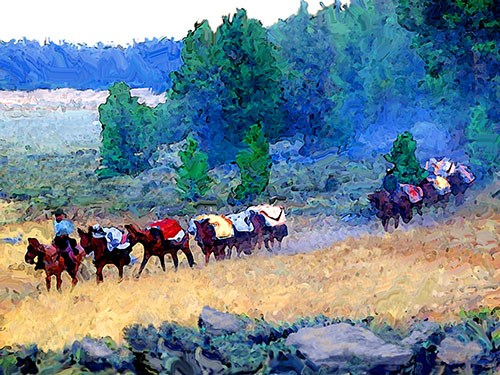
Long before highways crossed the San Luis Valley, travelers on horseback and mule trains followed routes through the region, carrying goods, exchanging supplies, and connecting distant communities.
One of those routes became known as the Old Spanish Trail, a historic trading network stretching from Santa Fe, New Mexico, to Los Angeles, California.
Although much of the trail crossed the deserts and mountains of the Southwest, its northern branch passed through the San Luis Valley.
A Journey Through the Valley
The Old Spanish Trail developed as a major commercial route beginning in 1829, when Antonio Armijo led a trading expedition from New Mexico to California.
During the following two decades, traders established several variations of the route, including the North Branch through Colorado.
The San Luis Valley offered a passage between mountain ranges, but travel was anything but easy. Caravans encountered sandy terrain, wetlands, river crossings, unpredictable weather, and difficult mountain passes.
Traders transported woven blankets and other goods westward, returning with horses and mules from California. The journeys could take months.
The routes were not entirely new. Indigenous peoples had traveled and traded across the region for generations before European explorers and commercial caravans arrived.
Two Routes Through the San Luis Valley
Historians have identified eastern and western routes through the Valley.
The eastern route generally passed through the area of present-day San Luis and Fort Garland, continued toward Crestone and Saguache, and eventually crossed the mountains by way of Cochetopa Pass.
Another route followed the western side of the Valley, with connections through the Conejos area and toward Monte Vista.
The precise locations of some sections remain subjects of historical research.
A Local Connection to Preservation
One of the most interesting chapters in the trail's modern history happened right here in Rio Grande County.
In 1994, people interested in preserving the trail gathered at the Rio Grande County Museum in Del Norte. Their efforts helped establish the Old Spanish Trail Association.
The group also worked to protect a surviving section of the trail from damage associated with a proposed access road.
That local preservation effort became part of a much larger movement to recognize the historic route.
In 2002, Congress designated the Old Spanish Trail as a National Historic Trail.
Discovering the Trail Today
Much of the original route has disappeared beneath modern roads, agricultural land, and the changing landscape. Nevertheless, the trail's history remains visible through museums, historic sites, and the communities that developed along its corridors.
Visitors interested in learning more can explore the Rio Grande County Museum in Del Norte, Fort Garland Museum, the Saguache Museum, and interpretive information at Great Sand Dunes National Park and Preserve.
The Old Spanish Trail reminds us that the San Luis Valley was never an isolated corner of Colorado. Long before today's highways and railroads, it was part of a far-reaching network connecting people, cultures, and commerce across the American Southwest. |
0 Comments
Join the conversation
Be the first to comment
Share your thoughts above.