
The Little Schoolhouses That Educated the Valley |
Remembering the rural classrooms that helped shape generations of San Luis Valley communities |
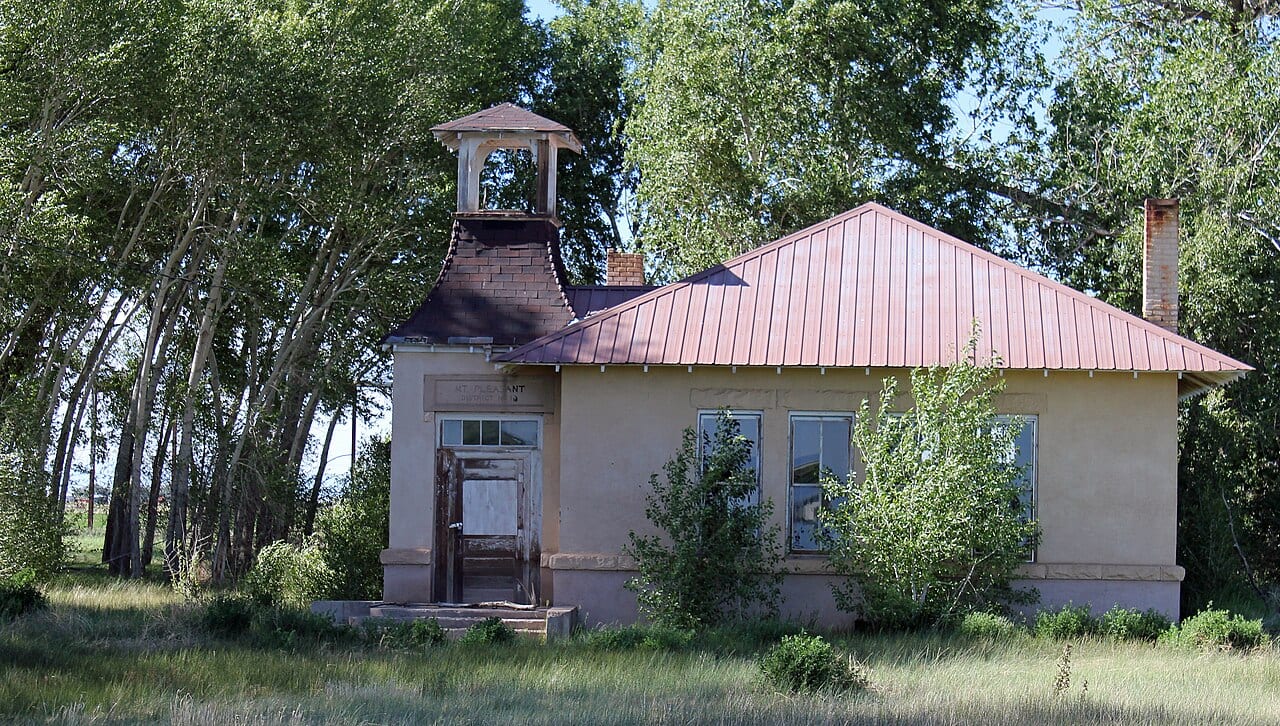
Long before school buses carried children across the San Luis Valley, education often began in a modest building surrounded by farmland, ranches, or a handful of homes. Some schoolhouses had just one classroom. A single teacher might be responsible for children of several ages, teaching reading, writing, arithmetic, and other subjects while tending to the daily needs of the school.
These buildings were more than places to learn. They were gathering places, community landmarks, and symbols of the determination of Valley families to provide their children with an education. Although many disappeared as rural schools consolidated, several surviving schoolhouses still tell the story of education in the Valley.
Mount Pleasant School: A Community Built Around Education
West of Alamosa, the historic Mount Pleasant School traces its beginnings to 1888, when German immigrant families organized a school district to serve their growing agricultural community. Its first classroom was a small wooden building measuring just 12 by 18 feet, relocated from the nearby Parma School.
As the community grew, residents built a brick schoolhouse in 1902. After storm damage, another building was constructed in 1911 using bricks made on the property. Students helped maintain the school by cleaning chalkboards, sweeping floors, and raising the American flag. Teachers sometimes traveled by horseback or bicycle, and one reportedly crossed the river by boat.
In 1921, local resident Ferdinand Higel purchased a Reo bus to transport children, helping spare them the long walk during harsh Valley winters. The school closed after the 1964–65 school year. Today, the building is listed on the National Register of Historic Places, preserving a piece of Alamosa County's educational history.
Garcia School: An Adobe Schoolhouse in Costilla County
In the small community of Garcia, near the New Mexico border, another historic schoolhouse tells a different chapter of the Valley's story. Garcia was originally known as Plaza de los Manzanares, a Hispanic settlement established in 1849.
The adobe schoolhouse served generations of local children. Historical records indicate it was transferred to the local school district in 1913 for one dollar, with the condition that it be used as a public school. Garcia School remained open until 1963, when consolidation sent students to Centennial Union School in San Luis.
The building later served as a library and Head Start facility before becoming vacant in the 1990s. In 2024, the Centennial School District and preservation partners were pursuing plans to restore the building as a community learning center, showing how an old schoolhouse can remain valuable long after its original classroom days have ended.
Crestone School: Education at the Foot of the Sangre de Cristos
At the eastern edge of the Valley, Crestone's historic schoolhouse reflects the community's early years as a mining and agricultural settlement. School District No. 8 was established around 1880, and residents contributed materials and labor to construct a one-room schoolhouse.
Children in grades one through eight attended classes there. As the community grew, the school expanded, adding another classroom in 1901. During the 1930s, the school introduced high school subjects and a hot lunch program. The building continued serving local students until 1949. Today, the historic Crestone Schoolhouse is recognized on the National Register of Historic Places.
Saguache County: Schools That Became Community Landmarks
Saguache County offers additional examples of how rural schools helped establish communities. The historic Saguache School and Jail Buildings include an adobe school constructed in 1874, during the community's early settlement period.
Farther north, the Sargents Schoolhouse was built in 1924 and served as an educational and social center for the surrounding community. After classes ended there in 1960, the Sargents building continued to serve as a community gathering place.
La Isla: A Schoolhouse for a Growing Community
In southern Conejos County, the small settlement of La Isla also had its own school. Built in the late 1930s with funding from the Works Progress Administration, the school reflected a period when federal programs helped rural communities improve public facilities.
Historical accounts describe folding doors separating the building into two classrooms, one for younger students and another for older children. The lower-grade classroom also included a stage used for performances and group activities. Like many rural schools, it provided space for community gatherings and celebrations.
When One Teacher Taught Every Grade
The daily routine of a one-room schoolhouse was quite different from what most students experience today. Teachers often worked with several grade levels simultaneously. While younger children practiced reading or arithmetic, older students might work independently on more advanced lessons.
Students sometimes helped maintain the classroom, carrying out chores ranging from cleaning chalkboards to tending the grounds. School buildings were often simple, and supplies could be limited. Yet these small schools offered something important: education close to home.
Why the Little Schools Disappeared
As the twentieth century progressed, improved roads, school buses, and growing expectations for educational facilities encouraged districts to consolidate. In Rio Grande County, numerous one-room rural schools were gradually replaced by larger consolidated schools serving communities including Monte Vista, Center, Del Norte, and Sargent.
The process brought expanded facilities and educational opportunities, but it also meant the closure of schoolhouses that had served individual communities for generations. Some buildings were converted into residences or community facilities. Others were abandoned or demolished.
Step Back Into the Wayside Schoolroom
The San Luis Valley Museum in Alamosa offers visitors a chance to experience a classroom from an earlier era. Its recreated Wayside country schoolroom reflects the small rural schools that once served Valley communities.
The exhibit is modeled on the former settlement of Wayside, associated with the Maddox Ranch. It offers a tangible connection to the schoolhouses where generations of Valley children received their education. The museum is located at 401 Hunt Avenue in Alamosa; visitors should confirm current hours before traveling.
Preserving the Valley's Educational Heritage
The surviving schoolhouses of the San Luis Valley represent more than an earlier approach to education. They tell stories about immigrant families establishing new communities, Hispanic settlements preserving their traditions, mining towns building permanent institutions, and ranching families working together to provide opportunities for their children.
A grandparent may have attended classes in one. A great-grandparent may have helped build another. Old class photographs, report cards, and family stories still connect present-day residents with the schools of earlier generations.
The little schoolhouses may have been modest, but the role they played in building our communities was anything but small.
|
0 Comments
Join the conversation
Be the first to comment
Share your thoughts above.