
Community Garden Builds Food Security in Crestone |
Crestone Community Garden combines local food, volunteer gardening and hands-on education |
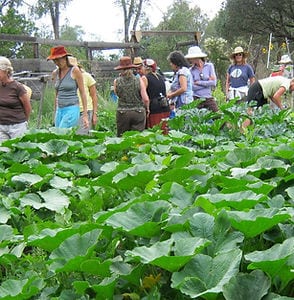
CRESTONE — On a modest patch of ground beneath the Sangre de Cristo Mountains, vegetables are doing more than filling baskets.
They are helping build food security, gardening knowledge and community connections in one of the San Luis Valley's most distinctive small towns.
The Crestone Community Garden is a volunteer-driven project that grows fresh produce for community members, local food assistance and senior programs while giving volunteers practical experience raising food in a demanding high-altitude climate.
The garden is supported through Saguache County Sustainable Environment & Economic Development, known as ScSEED, which describes the project as a grassroots effort focused on local food security, education and community resilience.
At the center of much of the garden's recent work is Ginny Ducale, an experienced gardener who has helped turn a relatively small plot into a remarkably productive space.
Recent reporting places the garden at roughly 50 feet by 75 feet, yet during the growing season it can provide vegetables, greens and herbs to dozens of people.
That is no small accomplishment at Crestone's elevation, where cool nights, a short growing season and sudden frosts can challenge even experienced gardeners.
The garden's modern story took shape around the time the COVID-19 pandemic forced communities everywhere to think more seriously about supply chains and access to necessities.
In Crestone and the Baca Grande, residents discussed how a remote community might become more self-reliant if normal systems were disrupted.
Food quickly became one of the practical concerns.
Volunteers responded by putting their hands in the soil and developing a garden that could produce food locally while teaching people how to grow it themselves.
Improving the soil took time, compost, minerals and steady work, but the effort gradually transformed the plot into productive ground.
The result is not simply a place where vegetables grow; it is a small piece of community infrastructure.
During the season, volunteers work the beds, tend plants and harvest what is ready.
Some of the harvest is shared among the people doing the work, while produce also reaches local residents through food assistance.
The garden has produced hardy crops suited to the Valley's conditions, including leafy greens, root vegetables, squash and herbs.
Fresh produce can be especially valuable in a rural food pantry, where canned, boxed and shelf-stable foods often make up much of what is readily available.
A head of greens or a summer squash harvested nearby offers something different: food that may have traveled only a few blocks before reaching a local kitchen.
ScSEED says the garden's reach includes food banks, seniors and community members, while volunteers gain knowledge they can carry into their own gardens.
That educational role is one of the project's most lasting contributions.
A vegetable can be eaten once, but learning how to prepare soil, plant seeds, recognize problems, conserve moisture and harvest successfully can serve someone for years.
Those skills have particular value in the San Luis Valley, where gardening requires adapting to altitude, aridity, strong sunlight and dramatic temperature swings.
The Crestone Community Garden has also worked with Crestone Charter School, giving young people hands-on experience planting seeds, tending plants and watching food develop.
For children, a garden can turn familiar classroom ideas into something they can touch.
Seeds germinate, roots spread, insects arrive, soil dries out and eventually something edible appears.
That process makes the origin of food far more tangible than anything printed on a package at the grocery store.
The garden has also become part of Crestone's wider community life.
Past community garden festivals and harvest celebrations have brought people together around food, plants, music, vendors and shared meals.
At a 2023 Harvest Moon Festival, much of the food served to attendees came from the Crestone Community Garden and other local gardens, showing how a growing space can spill naturally into community gathering.
The project's value is perhaps easiest to understand by separating food security from emergency food assistance.
A pantry can help provide food when someone needs it now.
A community garden adds another layer by developing soil, growing knowledge, volunteer networks and the ability to produce at least some food locally.
No garden this size can feed an entire community, and it does not need to in order to matter.
Its success can be measured in smaller ways: a bag of greens for a senior, zucchini for a pantry, a child learning to plant a seed or a volunteer discovering that high-altitude gardening is possible.
It can also be measured in the relationships formed while people weed, water and harvest together.
Crestone has long attracted people interested in sustainability, self-sufficiency, natural living and alternative approaches to community.
The garden turns some of those broad ideas into something practical.
There is little abstract about a vegetable bed.
Plants either receive the care they need or they do not, and a successful harvest can go directly into someone's meal.
The work also fits into a larger conversation happening around Saguache County and the San Luis Valley about local food systems.
ScSEED supports other community initiatives connected with sustainability and agriculture, including the San Luis Valley Seed Exchange, while regional groups continue working on food access and stronger connections between producers and consumers.
The Crestone Community Garden provides a neighborhood-scale example of what those goals can look like on the ground.
It does not depend on acres of farmland or a large commercial operation.
It depends on a usable piece of ground, people willing to work, soil that can be improved and a commitment to sharing what is learned and harvested.
Keeping it productive requires ongoing labor and resources.
Seeds, water systems, soil amendments, tools, repairs and volunteer time all become part of the yearly cycle.
ScSEED's fundraising information notes that the garden needs continued inputs and labor as it works to meet growing community needs.
That reality is part of the story too.
Community gardens can look effortless at harvest time, when beds are green and baskets are full, but abundance is built through months of preparation and repetitive work.
In Crestone, that work is producing something more enduring than a single season's vegetables.
It is preserving knowledge, introducing children to food production, helping fresh produce reach neighbors and giving volunteers a place to practice the skills behind local resilience.
Under the Sangre de Cristo Mountains, the Crestone Community Garden offers a reminder that community strength does not always begin with a large project.
Sometimes it begins with a small plot of soil, a handful of volunteers and a seed. |
0 Comments
Join the conversation
Be the first to comment
Share your thoughts above.