
The Underground Ocean That Keeps the Valley Alive |
Beneath the surface lies a hidden ocean sustaining life in the valley - uncover the secrets of its mysterious waters. |
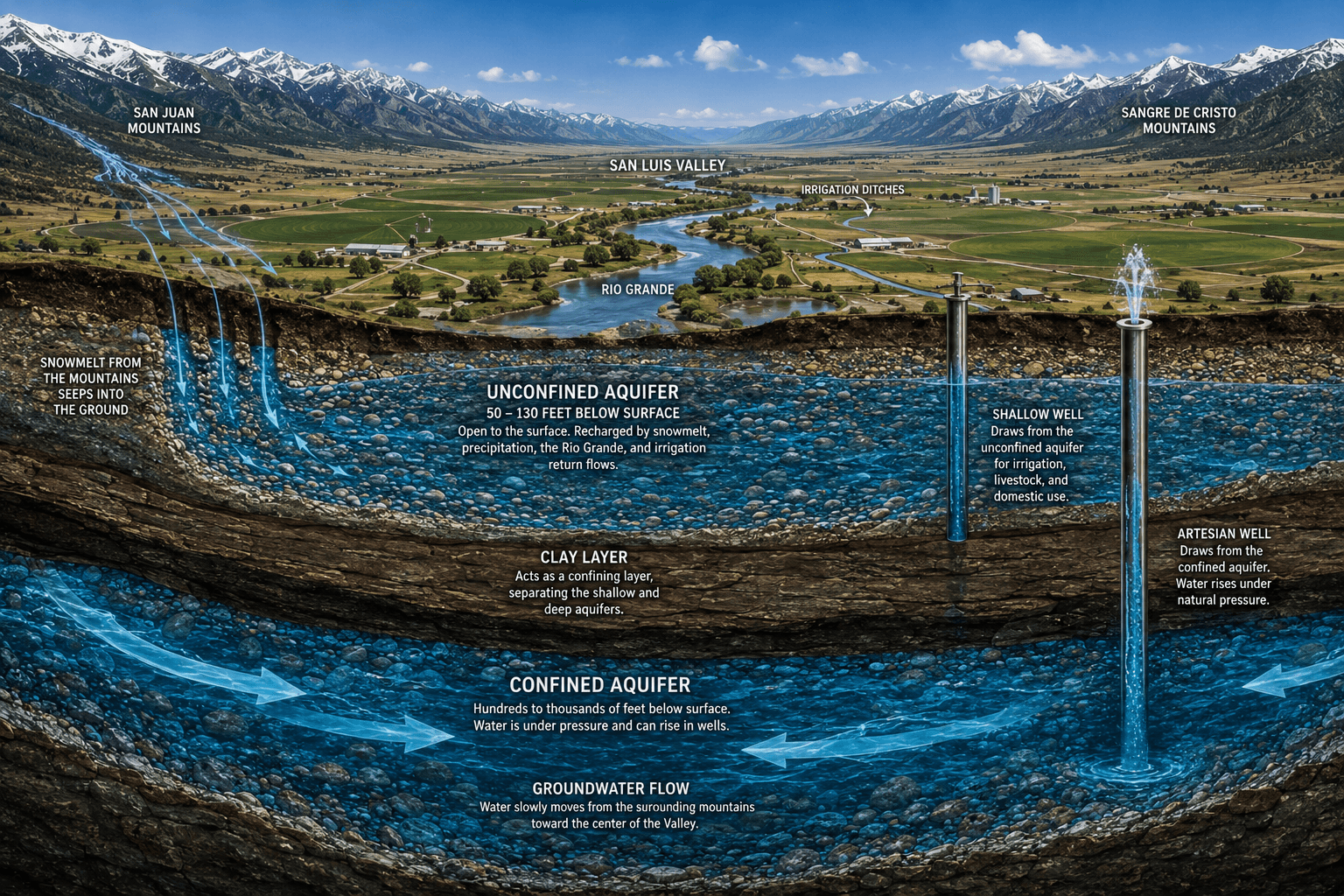
Stand anywhere on the floor of the San Luis Valley and you are standing on top of one of the most extraordinary water systems in the American West.
Beneath the surface — beneath the potato fields and the hay meadows, beneath the towns and the irrigation ditches — lies a two-layered aquifer system that has sustained agriculture in this high desert for over a century.
The shallow layer, called the unconfined aquifer, sits 50 to 130 feet below the surface. Below that, separated by a layer of clay, lies the deep confined aquifer. Together, they hold water that fell as snow in the surrounding mountains and slowly worked its way down into the basin, sometimes taking hundreds of years to make the journey.
For most of the 20th century, Valley farmers drew on this system and it held. Then the droughts came. Starting in 2002, a sustained dry period began drawing down the unconfined aquifer faster than snowmelt could refill it. By the estimates of state water managers, the unconfined aquifer has lost more than one million acre-feet of storage since then.
As of the most recent readings, it sits at its lowest recorded level — a number that landed hard in farming communities that have already spent years and millions of dollars trying to stabilize it.
The response has been significant and ongoing. Colorado has required farmers in the most stressed areas — primarily north of the Rio Grande River in the central Valley — to retire wells, fallow thousands of acres of productive farmland, and pay fees on every gallon they pump.
Subdistricts have been formed to manage pumping collectively. The state has enforced increasingly strict timelines for aquifer recovery. Some farms have simply stopped operating, their land dried up in exchange for water credits. It is a painful, necessary, and still-unresolved process.
The stakes go beyond the Valley itself. The Rio Grande Compact — a 1938 agreement between Colorado, New Mexico, and Texas — requires Colorado to deliver a certain amount of water across the state line each year.
Groundwater pumping in the Valley affects how much the Rio Grande carries. When the aquifer drops, so does the river, and when the river drops, Colorado's compact obligations become harder to meet.
Douglas County has even explored purchasing Valley water rights to pipe water north to the Denver suburbs — a proposal that hasn't gone away and that Valley communities have fought hard to resist.
The underground ocean is still there. The question the Valley is working through right now — farm by farm, well by well, acre by fallow acre — is whether it can be refilled before it reaches a point of no return.
|
0 Comments
Join the conversation
Be the first to comment
Share your thoughts above.